








Eco-Friendly Cosmetics: How to Recognize “Greenwashing” on Labels
The global cosmetics market is undergoing a true revolution—we all want products that are safe for our skin and gentle on the planet. The industry quickly caught on to this desire, but instead of actually changing its formulas, it often changes only its marketing. This phenomenon is called “greenwashing”—the practice of creating a false illusion of sustainability.

With modern digital design tools, it is a matter of minutes to create a label with a kraft texture, green leaves, and minimalist fonts that subconsciously scream “pure nature” at us. But the truth does not lie in the beautiful packaging; it lies in the molecular reality of the composition. Here is how to read labels like a real biologist and avoid falling into the marketing trap.
The Illusion of “Green” Words
The first rule when choosing cosmetics is to ignore the loud claims on the front of the packaging. The claims there are often legally unregulated.
“Natural“: In many countries, there is no strict legal standard for this word. A product can contain 1% chamomile extract and 99% synthetic petrochemicals and still be legally labeled as “natural.”
“Clean“: This is an entirely marketing term. “Clean” for one brand may mean the absence of parabens, while for another—simply the absence of artificial fragrances, without guaranteeing an ecological origin.
“Chemical-free“: From a purely scientific point of view, this is the most absurd claim. Everything in the universe is built from chemical elements, including water (H2O) and pure olive oil. The real question is whether the compounds are biocompatible and biodegradable.
The INCI List: The Product’s True DNA
The only place where a brand cannot lie to you is the ingredient list on the back (INCI – International Nomenclature of Cosmetic Ingredients). It is read by one simple rule: the ingredients are listed in descending order according to their concentration.
If a foundation advertises that it is “with organic argan oil,” but the oil (Argania Spinosa Kernel Oil) is at the very end of the list—after preservatives and perfume—then its quantity is less than 1% and its real effect on the skin is zero.
Visual Greenwashing: The Design Trap
Our perception is easily manipulated through visual stimuli. Packaging in matte green or brown creates a subconscious sense of sustainability.
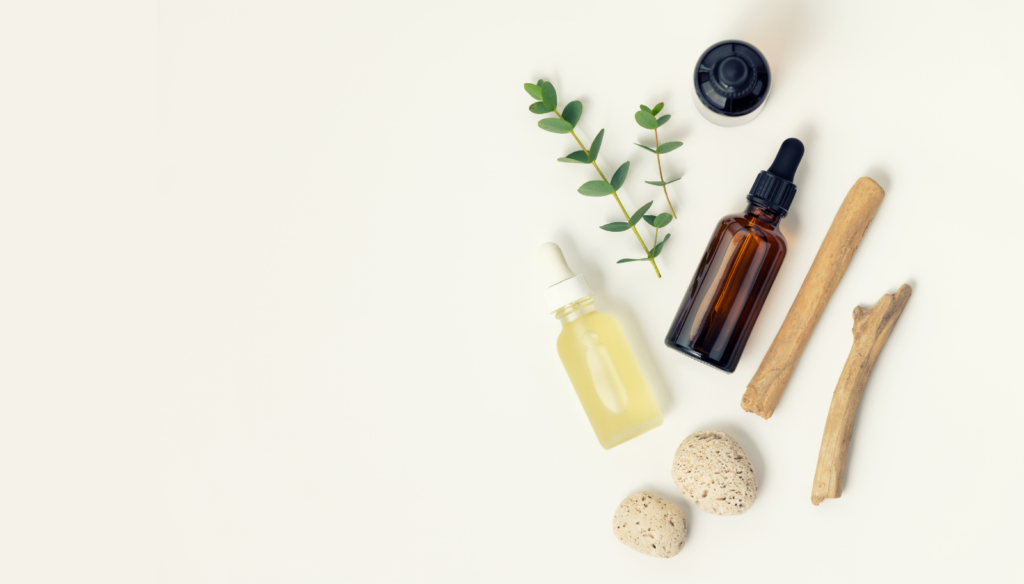
A common practice is the use of plastic that is colored to imitate recycled glass or wood. If a brand is truly eco-friendly, it will use glass, aluminum, or biodegradable materials and clearly state it (e.g., with recycling instructions or an option for refills), instead of simply relying on an “earthy” color palette.
Quick Reference: Marketing vs. Reality
| What is written on the package | What we think | What it actually is (most often) |
| “With green tea extract” | The product is based on herbs. | Green tea is under 1%, and the base is silicone or mineral oil (petroleum derivative). |
| “Vegan” | The product is entirely natural. | It only means there are no animal ingredients. It can be 100% synthetic. |
| “Dermatologically tested” | Guaranteed safe and healing. | It only means it was tested on skin (even if the result was redness). |
Certificates You Can Trust
So that you don’t have to be a walking chemical laboratory, the safest way to avoid greenwashing is to look for official certificates from independent organizations. They have strict audits and do not allow for marketing tricks.
COSMOS / Ecocert: One of the strictest standards in Europe. It guarantees that a high percentage of the ingredients are from organic farming and that production processes are environmentally friendly.
Leaping Bunny: The only globally recognized certificate that guarantees 100% that the product and none of its raw materials have been tested on animals.
NATRUE: This seal guarantees the absence of synthetic fragrances, silicones, and microplastics.
The informed consumer is the greatest enemy of greenwashing. When we learn to read beyond the beautiful design and focus on the biological reality of formulas, we not only protect our cells from toxins but also vote with our money for an industry that truly respects the planet.